
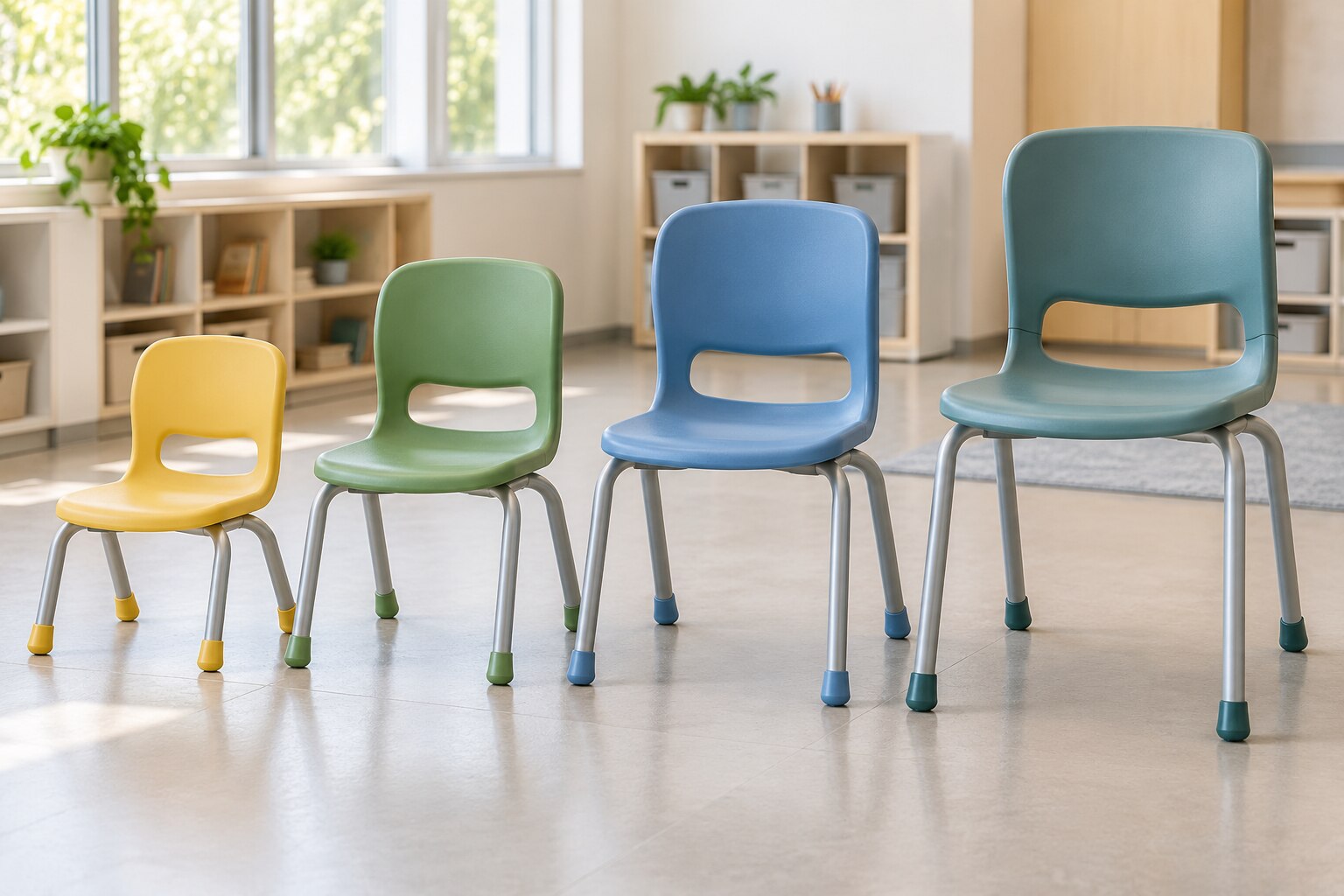
A chair that fits a three-year-old can leave an eight-year-old cramped, while a chair labelled “kindergarten” may still be wrong for children with different body proportions. By the end, you will be able to compare chair dimensions, measure children, pair seats with desks, and judge whether a fixed, adjustable, or mixed-size set suits each learning space.
Key takeaways
- Match chair height to popliteal height, not grade level.
- Measure hip breadth and thigh length before selecting a seat.
- Check seat, backrest, and table dimensions together.
- Ask manufacturers for size-class measurements and tolerance ranges.
How manufacturers divide seating into measurable age and size groups
A chair is not sized by grade alone: manufacturers begin with stature, popliteal height, hip breadth, and thigh length, then match the result to a chair-and-table size class. The same five-year-old label can conceal a size difference large enough to leave one child dangling or another cramped.
EN 1729-1 defines coordinated size classes. Its chair-height sequence is approximately:
- Size 0: 260 mm
- Size 1: 310 mm
- Size 2: 350 mm
- Size 3: 380 mm
- Size 4: 430 mm
- Size 5: 460 mm
- Size 6: 510 mm
| Age group | How proportions change | Typical application |
|---|---|---|
| Preschool | Low seat, shallow depth, narrow width, and a low backrest keep feet supported and movement controlled | Preschool chairs |
| Kindergarten | Slightly greater seat depth and width support active sitting without losing floor contact | Kindergarten chairs |
| Primary school | Longer seat depth, broader seat, taller backrest, and firmer frame support sustained desk work | Primary classroom chairs |
| Middle school | Increased width, depth, back height, and frame stiffness accommodate larger bodies | General classrooms and specialist rooms |
| High school | Largest seat dimensions and strongest frame handle adult-sized loads and longer work periods | Secondary classrooms |
These labels guide production; they do not replace measurements. As children grow, manufacturers increase shell stiffness, frame section, or both instead of scaling every dimension equally. Chair height must also match the desk: the wrong pairing causes raised shoulders, restricted leg clearance, or slouching.
US purchases should identify ANSI/BIFMA X6.1 and its exact test scope rather than assume EN 1729 applies.
How to measure a child and match the chair to the body
Measure popliteal height, buttock-to-knee length, hip breadth, and seated trunk height—not age or school grade. These child anthropometric measurements reveal whether the chair lets a child sit upright, move freely, and stand without adult help.
| Measurement | How to take it | Chair match |
|---|---|---|
| Popliteal height | Measure from the floor to the underside of the knee while seated, wearing classroom shoes. | Choose a seat height that lets both feet rest flat, with knees near 90 degrees and thighs supported. Compare it with the EN 1729-1 size sequence: 260, 310, 350, 380, 430, 460, or 510 mm. |
| Buttock-to-knee length | Measure from the back of the pelvis to the crease behind the knee. | Select seat depth about 20–30 mm shorter, leaving space behind the knee. Excess depth forces the child to slide forward; too little depth reduces thigh support. |
| Hip breadth | Measure across the widest part of the hips while seated. | Choose seat width at least 20–30 mm wider, allowing movement without letting the child lean sideways to stay balanced. |
| Seated trunk height | Measure from the seat surface to the shoulder or lower shoulder-blade area. | Check that the backrest supports the lower back without pressing into the shoulder blades. |
A three-year-old and a five-year-old can need different seat height even in the same room. An eight-year-old with longer legs may need a higher seat but still require a depth that leaves knee clearance. Test the actual child in the chair before ordering a complete set.
How seating accommodates children who are shorter or taller than average
Use size bands when children’s measured stature clusters around two or more coordinated chair heights, mixed-size classroom sets when one class contains distinct short and tall groups, and adjustable school chairs when the same seat must serve a wide range over several years.
| Option | What it means | When it applies |
|---|---|---|
| Size bands | Fixed-height chairs selected from two or more standard classes | Use when measurements show clear groups, such as children needing 310 mm and 350 mm seats |
| Mixed-size classroom sets | A planned quantity of different fixed-height chairs in one room | Use when a class includes shorter and taller pupils; label each size and place the correct chair with the matching desk |
| Adjustable school chairs | Seats with a defined height range and a locking mechanism | Use for shared rooms, rapid growth, or small enrolment where separate inventories would leave unused chairs |
Choose the chair and desk as a pair. A tall chair under a low desk leaves insufficient desk clearance for the thighs; a low chair under a high desk raises the shoulders and encourages leaning. EN 1729-1 coordinates chair-and-table size classes, while a US project should identify the applicable ANSI/BIFMA X6.1 edition and test scope.
Do not use one fixed-height size simply because every pupil shares a grade. A short child whose feet do not reach the floor may slide forward, while a taller child with compressed knees loses usable desk clearance.
Check seat height, thigh clearance, and foot contact after fitting; reject any adjustable model that cannot lock securely or leaves controls accessible during normal movement.
Why classroom use changes the design of the chair
A chair for five-year-olds is not automatically suitable for every room used by five-year-olds. The activity determines whether the priority is movement, stability, cleanability, noise control, or prolonged support.
| Setting | Design priority | Why it matters |
|---|---|---|
| Kindergarten activities | Low mass, short seat depth, rounded front edge, and both feet flat on the floor | Kindergarten activity chairs must let children stand, turn, and sit independently without seat-edge pressure or tipping. |
| Primary classrooms | Correct EN 1729-1 size class, stable frame, and practical stacking | Children need frequent movement, while staff need safe storage between lessons. |
| Laboratories | Wipe-clean, chemical-resistant surfaces, stable four-leg bases, and no uncontrolled rolling | Laboratory chairs must survive spills and keep pupils steady near benches, equipment, and hot materials. |
| Computer rooms | Desk clearance, foot support, compact footprints, and controlled movement | Computer chairs that roll or sit too high can leave feet unsupported and pull children away from the keyboard. |
| Libraries | Quiet glides, supportive backs, and easy repositioning | Good library seating design reduces scraping noise without making chairs difficult to move. |
| Older-student task areas | Greater seat depth, stronger frames, and support for longer sessions | Older students need furniture that suits sustained writing, reading, or technical work rather than brief group activity. |
Specify floor glides for the actual surface: felt quiets hard floors but collects grit, while hard nylon can mark resilient flooring. Replaceable cartridges reduce maintenance.
Check stacking at the stated stack height; tall stacks create handling hazards. EN 1729-1 covers dimensions, while EN 1729-2 covers safety, strength, and durability. Passing one does not prove the other.
What to verify when comparing manufacturers and classroom seating specifications
Verify measured dimensions, test evidence, and service details—not labels such as “kindergarten” or “junior”—before approving a chair. Record seat height, seat depth, seat width, backrest height, foot clearance, and the matching desk height, with permitted tolerances.
| Check | Evidence to request | Failure if missing |
|---|---|---|
| Dimensions | Dimensioned drawing and coordinated chair-table size | A suitable chair paired with a high desk raises shoulders; a low desk restricts knees |
| European compliance | EN 1729-1 for functional dimensions and EN 1729-2 for safety, strength, and durability testing | Passing the dimensional standard alone does not prove mechanical durability |
| US compliance | Exact ANSI/BIFMA X6.1 edition, test scope, and report | “Commercial grade” provides no defined performance evidence |
| Construction | Frame material, joint method, fastener access, edge radii, stability, load rating, and pinch-point controls | Loose joints, sharp edges, or tipping appear after daily use |
For school furniture procurement, ask each manufacturer for:
- Cleanability of upholstery and plastic surfaces, including approved detergents and stain limits.
- Replaceable glides, seat shells, backs, and fasteners, plus parts availability and repair instructions.
- Warranty exclusions for casters, active-seat mechanisms, and misuse.
- A sample chair for staff to inspect with children before ordering.
Casters and active seating add movement and maintenance points; use them only where staff can control movement and test evidence covers that environment. If Arko Global is shortlisted, place its sample and specification sheet in the same comparison matrix as every competing bid.
Frequently asked questions
How do school chair manufacturers divide seating by age group?
Manufacturers use measurable size classes based on stature, popliteal height, hip breadth, and thigh length rather than age or grade alone.
How do you measure a child for a school chair?
Measure the child’s popliteal height, hip breadth, thigh length, and stature, then compare those measurements with the chair and table dimensions.
What if a child is shorter or taller than average?
Choose the size class that matches the child’s body measurements and provide a different chair or adjustable option when the standard class leaves feet unsupported or thighs cramped.
Why are classroom chairs designed differently from household chairs?
Classroom chairs must withstand repeated movement, support active learning, fit classroom tables, allow efficient cleaning, and remain stable during daily group use.
What should you compare between school chair manufacturers?
Compare seat height and depth, seat width, backrest dimensions, table compatibility, materials, load rating, stability, cleanability, and the stated size-class measurements.