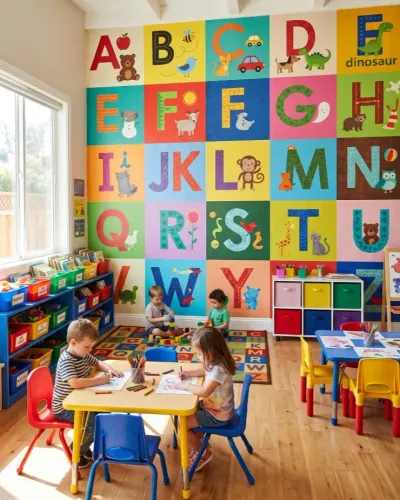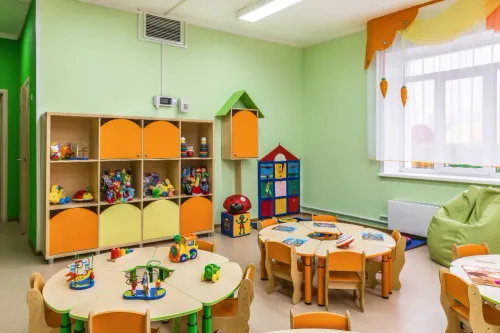
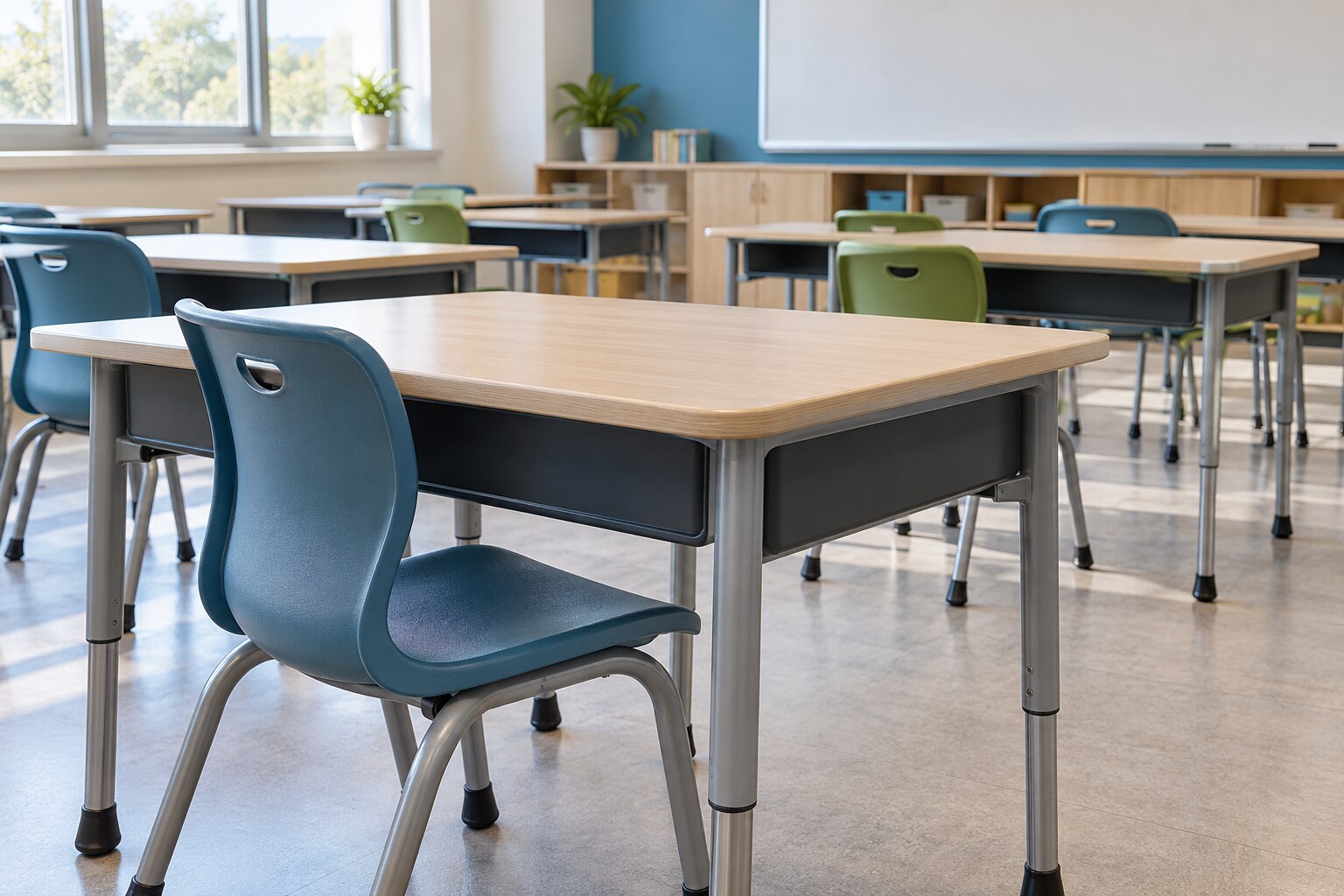
A supplier’s catalogue and the word “safe” do not tell you whether its furniture will fit children, survive daily cleaning, or arrive ready for use. By the end, you will have a practical way to verify the supplier, test the furniture, compare documents and construction, and calculate the real cost of the order.
Key takeaways
- Verify the legal manufacturer, production site and named service contact.
- Request product-specific test reports, certificates and safety documentation.
- Inspect an exact sample for stability, edges, joints, cleaning and ergonomics.
- Compare delivered cost, warranty, lead time, replacements and installation support.
Verify Who Will Make, Test and Support the Furniture
A genuine classroom furniture supplier can connect your purchase to a legal entity, a physical production site, a named product model and a reachable service team. A catalogue or showroom proves none of these.
Use your classroom furniture supplier checklist to request business registration details, the factory address, and the name of any contract manufacturer; this distinguishes a manufacturer versus reseller without relying on sales language.
Request documents that identify who controls production and testing:
- A registration certificate or equivalent company record matching the quotation and invoice entity.
- A factory address, production photographs or video, and a site-visit option; if manufacturing is outsourced, obtain the subcontractor’s name and responsibility.
- Product drawings, a bill of materials, model numbers, revision dates, and written quality-inspection steps.
- Complete test reports naming the exact model and configuration, test laboratory, test date and standard edition. ANSI/BIFMA is a product-category standard, not blanket proof that every item from a factory complies; “BIFMA certified factory” is insufficient.
- A warranty showing coverage, exclusions, response times, installation responsibility and the after-sales contact handling claims.
- Priced replacement parts, installation instructions and the process for reporting concealed damage, defects and missing components.
Call the named service contact before awarding the order. Ask who handles a failed caster, damaged edge or unsafe unit, how quickly they respond, and whether parts remain available after the warranty ends. Vague answers, mismatched company names or reports that cover another model are evidence to pause the purchase.
Demand Product-Specific Proof of Safety and Compliance
Do not accept a supplier’s word that furniture is safe: require a report or certificate tied to the exact model, materials, dimensions and configuration you will buy. Ask for the test laboratory, report date, standard edition, sample photographs and any failures or corrective actions. A factory-level claim is not product evidence.
Check the physical safeguards in the specification:
- Rounded, smooth edges and fasteners that children cannot reach or loosen.
- Pinch-point protection at hinges, folding parts, drawers and sliding seats.
- Tip-over resistance for storage units, mobile shelving and climbable furniture, plus the anchoring method, installation instructions and loading limits.
- Stable bases, age-appropriate dimensions and non-toxic finishes, supported by coating or emissions test results.
Request these documents and check what each one actually covers:
| Document or claim | What to verify | Why it matters |
|---|---|---|
| Bureau of Indian Standards compliance | Indian Standard number, product scope and complete test report | A generic BIS reference does not prove this model complies |
| EN 1729-1 and EN 1729-2 | Tested sizes, dimensions and laboratory report | These address functional sizing and safety for educational furniture |
| ANSI/BIFMA claim | Edition, model, configuration, laboratory and full report | “BIFMA certified” is not blanket certification |
| ASTM F2613 education furniture standards | Exact chair or stool model for children approximately 2–5 years old | Casters, arms or shell changes can invalidate the evidence |
| TSCA Title VI | Panel manufacturer and certification for MDF, particleboard and hardwood plywood, including hidden panels | Composite wood emissions and records apply to covered U.S. products |
| GREENGUARD Gold under UL 2818 | Certified configuration, finishes, adhesives, laminates and upholstery options | The certificate does not automatically cover alternatives |
| CPSC Children’s Product Certificate | Exact model, age grading and accessible components | Regulated children’s products require applicable third-party evidence and certification |
Compare Construction, Ergonomics and Cleanability Instead of Photographs
Compare physical specifications and failure evidence, not polished photographs, to judge whether furniture will survive daily use and fit the children assigned to it.
| Comparison | Evidence to request | What failure reveals |
|---|---|---|
| Construction | Board thickness, edge banding, weld quality, joint type and fasteners, plus load ratings for shelves, seats and tabletops | Thin panels, exposed fasteners or weak welds shorten service life and create snag points |
| Ergonomics | A dimension chart linking child height to seat height, desk height and seat depth; confirm foot support and knee clearance with the supplied frame | Correct seat height alone does not prove a usable table-and-chair combination |
| Cleanability | Finish and upholstery specifications, including disinfectant resistance, seam design and upholstery density | Porous fabric, open seams or a finish damaged by routine disinfectant increases hygiene and replacement work |
| Mobility | Caster diameter and type, brake operation, replacement availability and stability with brakes unlocked | A lockable caster does not stop rolling while a child climbs or leans |
For inclusive classroom furniture, assess the complete setting: approach from the required side, armrest interference, turning space and controls that children can operate without pinch or shear points. Ask for drawings showing the modesty panel and frame, because an accessible nominal height can still block a wheelchair or restrict knee clearance.
Use the same child height range and loading scenario for every supplier. Request priced replacement part numbers for glides, casters, seat shells, tabletops and upholstery; otherwise a failed edge or caster can force replacement of an entire unit. Check that the tested model matches the supplied arms, casters, shell and finish.
Inspect an Exact Sample and Run a Representative Classroom Pilot
Approve a bulk order only after a classroom furniture sample inspection of the exact models, dimensions, casters, edge profiles and finishes you will receive.
Run a kindergarten furniture pilot in a room with children, teachers and the actual storage units. Do not substitute a showroom version: a different shell, caster, fabric or coating can change the result.
1. Check every contact surface by hand. Look for sharp edges, exposed screws, loose joints, unfinished board edges, drawer stops that prevent overextension, snagging points and fabric seams that children can pull. Record the finish odour after unpacking and again after 48 hours.
2. Test wobble and stability with normal pushing, leaning and climbing pressure. Open drawers and doors, load shelves, and check tall units for movement; a heavy base does not prove tip-over resistance. Confirm the anchoring method and loading limits.
3. Test mobile pieces in both conditions you will use: brakes locked during activities and casters free during reconfiguration. Ask for caster diameter, brake operation and replacement availability, then observe rolling resistance, turning and stability with brakes unlocked.
4. Time stacking, cleaning and corridor movement. Test chairs stacking, tables nesting, adults carrying units, and children moving around corners without pinch points. Watch noise, blocked routes and whether wet cleaning leaves trapped moisture in joints.
Arko Global should provide the pilot against the purchase specification, so any approved sample becomes the reference for colour, dimensions, hardware and finish—not merely a photograph.
Related products
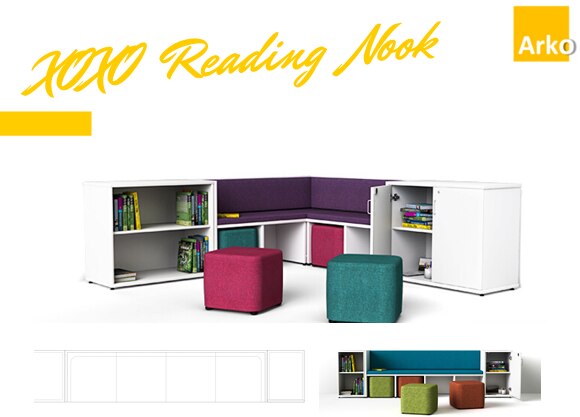 | KINDERGARTEN TABLES The XOXO Reading Nook is the perfect element to include into any classroom that needs a quiet reading space. View product → |
 | SHAPES / LAYOUTS Arko Global is one of the leading manufacturers of kindergarten shapes and layouts in Bangalore, specializing in creative, safe, and child-friendly... View product → |
Make the Quotation and Service Promise Comparable
Compare the total installed cost, not the classroom furniture quotation’s per-unit pricing. Require separate lines for GST, freight, unloading, assembly, anchoring, site measurement, layout revisions, and payment milestones; a low unit figure can hide expensive site work.
| Quotation line | Confirm in writing | Cost consequence |
|---|---|---|
| Commercial | Per-unit price, GST, payment milestones, warranty, lead time, and exclusions | Reveals the amount and timing of cash required |
| Delivery and installation | Packaging dimensions, pallet or carton count, delivery condition, inside-delivery requirements, unloading, assembly, anchoring, site measurement, layout revisions, and the concealed damage reporting process | Shows whether doors, lifts, labour, drilling, and installation add charges |
| Service and replacement | After-sales contact, priced replacement parts, availability of caster glides, fasteners, seat shells, tabletops, and upholstery | Exposes the cost of keeping one unit operating through its refresh cycle |
Ask whether furniture arrives assembled. A unit that cannot pass through a classroom door can turn a freight quote into a dismantling, carrying, and reassembly bill. Record damage before signing delivery documents, and obtain the deadline and photographs required for a concealed damage claim.
For mobile units, specify whether casters stay locked during use, move during reconfiguration, or must do both. Request the caster type, diameter, brake operation, stability with brakes unlocked, and replacement price.
Check that colours, upholstery and replacement parts remain available for the planned upholstery refresh cycle; replacing a complete chair for one failed caster costs more than the original saving.
Frequently asked questions
How can you verify who makes and supports classroom furniture?
Match the supplier’s legal entity to its business documents, production-site details, named product models and reachable after-sales team. Ask who handles warranty claims, replacement parts and installation.
What safety and compliance proof should classroom furniture suppliers provide?
Request documents tied to the exact product model, including test reports, certificates, material details and manufacturing records. Check model numbers, test dates, issuing laboratories and whether the documents cover the supplied configuration.
How should you compare classroom furniture beyond catalogue photographs?
Compare frame materials, joint construction, load stability, edge treatment, dimensions, posture support, cleanability and replacement of worn parts. Photographs cannot confirm these details.
Why inspect a sample and run a classroom pilot before ordering?
An exact sample lets you check finish quality, wobble, pinch points, sharp edges, storage access and cleaning effort. A representative pilot reveals how the furniture works with real children, teaching routines and room layouts.
Related products
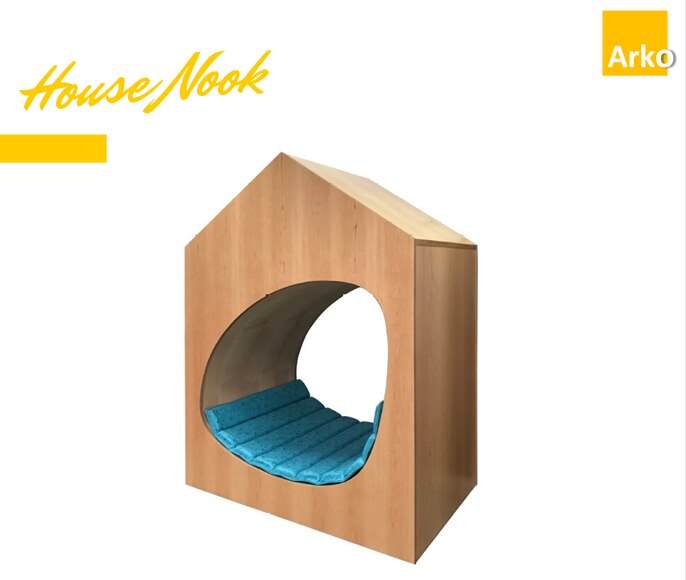 | KINDERGARTEN TABLES A cozy place to read a book alone or with a friend. Colorful fabric an finish options can really brighten up library or school spaces and make it... View product → |
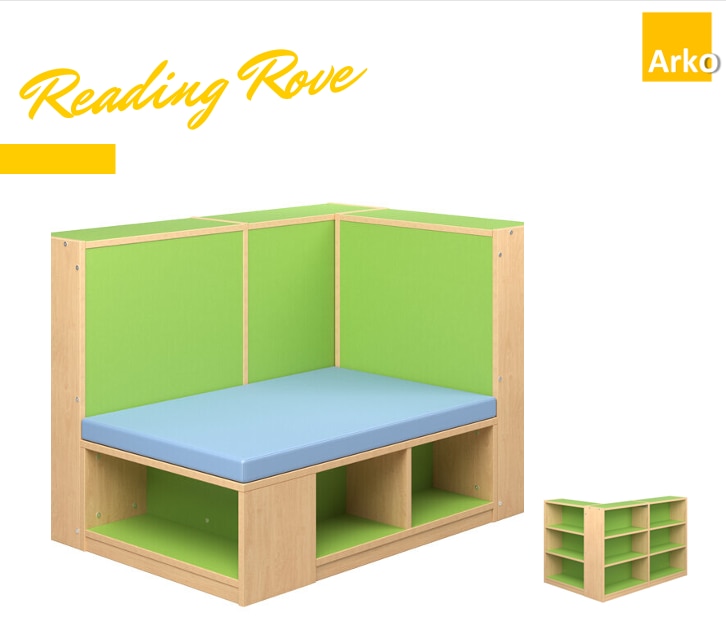 | KINDERGARTEN TABLES After picking out a book, you need to find a comfortable place to enjoy it. View product → |