Creative learning depends on more than tables and chairs: children need furniture that supports making, sorting, building, moving, cleaning up and working together. By the end, you will be able to match each activity with an appropriate furniture format, check critical dimensions and plan a room that changes smoothly from free choice to guided instruction.
Key takeaways
- Match furniture to actions such as pouring, building, painting and pretending.
- Specify table height, work surface size and the number of children per station.
- Separate noisy, messy and quiet activities to improve movement and supervision.
- Check stability, rounded edges, cleanability, storage access and repairability before buying.
What counts as activity furniture in a kindergarten room?
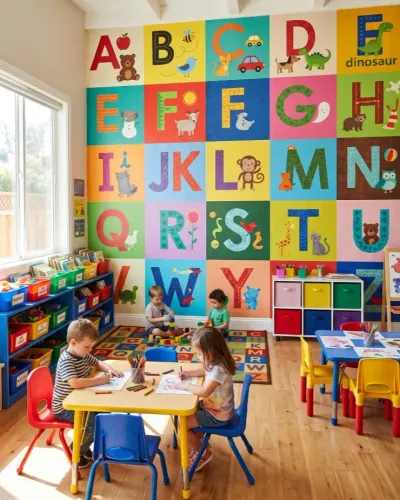
Activity furniture is any movable or fixed classroom element that lets children handle materials, test ideas, collaborate and work independently. It supports hands-on learning and creative learning, not only seating or quiet reading. Choose it by the action children need to perform: pour, compare, assemble, paint, pretend, revise and put materials away.
| Option | What it enables | Useful example |
|---|---|---|
| Low table | Sorting and focused work | Bears, buttons, pattern blocks or puzzles |
| Floor mat | Building on a defined surface | Blocks and loose parts |
| Open shelf | Independent access | Removable bins of manipulatives |
| Washable surface | Messy creative work | Painting and drawing |
| Role-play structure | Imaginative collaboration | Dramatic play |
| Sensory station | Material exploration | Sand, rice or play dough |
| Project table | Group construction | Shared art or investigation |
Sensory play furniture ideas should include a station with a stable basin or tub, splash-resistant surroundings and storage for tools and drying materials. A puzzle table can serve one or two children without turning focused work into an adult-led task.
Keep heavy construction blocks and dense sensory materials in low bins. Place frequently used items on open shelving so children can remove and return them without lifting a container above shoulder height. Tall shelving needs secure anchoring; a classroom activity centre is not exempt from tip-over risk.
Which furniture format fits each kindergarten activity?
Match the format to the activity’s movement, mess and social pattern, not to a generic “kindergarten” label.
| Format | Best fit | What to check |
|---|---|---|
| Low rectangular table | Low tables for manipulatives, puzzles, drawing and two- or four-child work | Stable base, knee clearance and washable work surfaces |
| Trapezoid, wedge or semicircular table | Pairs, small-group clusters or a teacher-led arc | Leg geometry can reduce knee space; drawings must show the clear opening and accessible configurations |
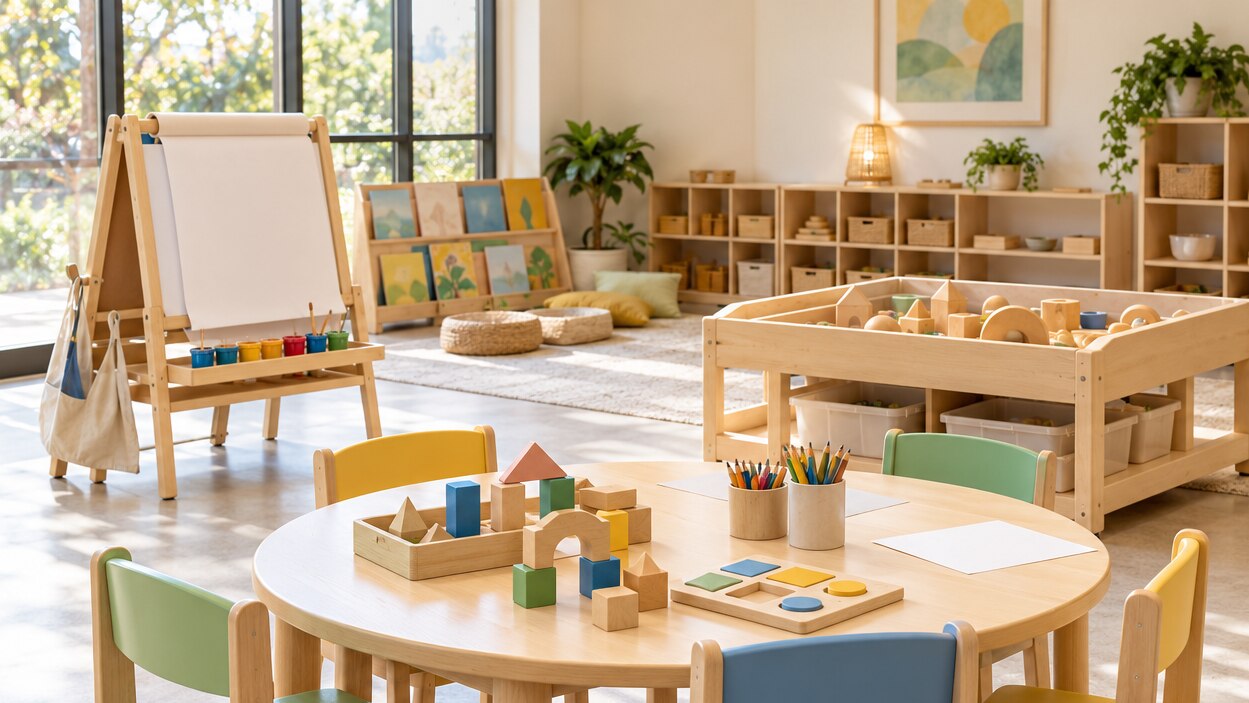
| Easel | Standing painting and drawing | Sealed surface, stable base, paper and brush storage, and a place for drying work |
| Floor setup | Floor mats for block play and loose-parts construction | Define a build zone so children need not lift tall structures onto tables |
| Workbench | Making and tool-based projects | Correct height, treated edges and a clear supervision line |
| Modular seating | Discussion, dramatic play and project reflection | Easy reconfiguration without blocking circulation |
| Mobile cart | Paint, clay, water-play tools or documentation materials | Locking casters and safe movement between stations |
| Open shelving or storage wall | Independent material selection and return | Secure tall units; keep heavy bins low and removable without lifting overhead |
Use a separate activity station when sensory play or water play needs a boundary. Keep its basin, tools and drying area together. Do not use a tall unit as a room divider if it blocks supervision or creates a circulation hazard.
What dimensions and group sizes should you specify?
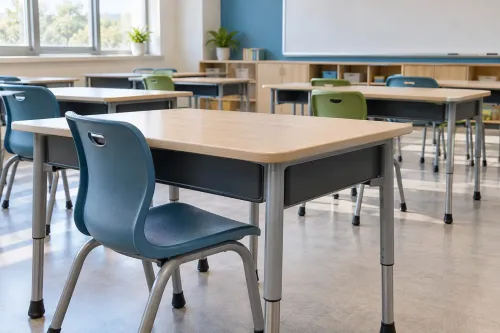
Specify each seat height with its matching table height, not as furniture described only as “child-sized.” EN 1729-1 defines discrete size classes, including nominal seat heights of about 260, 310 and 350 mm paired with table heights of about 460, 530 and 590 mm.
Confirm the class or actual dimensions against the children using the room; one kindergarten may need more than one pair.
- One-child station: puzzles or focused drawing.
- Two-child table: sorting, manipulatives and partner work.
- Four-child table: construction, painting and art.
- Six-child table: collaborative project work.
Check foot support, knee clearance and shoulder position at the working surface. For an inclusive table position in the United States, reserve at least 30 inches of width and 48 inches of clear floor length, with knee clearance at least 27 inches high, 30 inches wide and 19 inches deep.
Aprons, centre legs and storage must not consume that opening.
Leave clear paths between stations and around pull-out seats, carts and accessible positions. Product drawings must show the clear opening, not just tabletop dimensions, and identify which configurations remain accessible. A four-leg rectangular table often provides more predictable wheelchair positioning than a shaped table with central or angled legs.
A trapezoid, wedge or semicircular table can support group layouts, but inspect its leg geometry before accepting the stated table height.
How can you arrange stations for movement, noise and supervision?
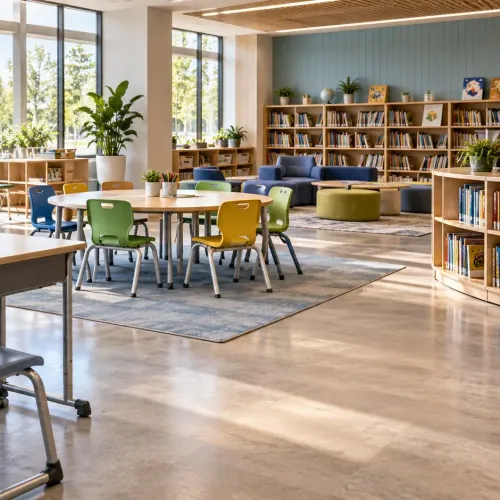
Put each station where its mess, sound and traffic will not undermine another activity. This classroom arrangement keeps supervision sightlines open while giving children clear ownership of materials.
- Place messy activities and water-based work near a sink, durable flooring and a drying area. Keep paint, glue and sensory materials away from upholstered furniture.
- Set block play and loose-parts construction on a broad floor mat, positioned so tall builds do not obstruct the main route.
- Locate dramatic play beside open storage, allowing children to collect and return props without placing its movement zone in the doorway.
- Put puzzles, drawing and small manipulatives along a quieter room edge, away from blocks and pretend-play traffic. This separates quiet activities from noisy activities.
- Reserve a visible teacher-led table or arc where every child can see demonstrations without crossing another station.
- Keep the centre open for whole-class meetings, movement and large collaborative work.
Make the layout flexible without repeated heavy lifting. Choose tables with positive-locking casters that stay stable when children lean on them or join them; swivel-only locks are not enough. Staff must operate the locks easily, while children cannot release them accidentally.
Use nesting tables for quick footprint changes, stackable seating where storage and handling are safe, and lightweight modules staff can move easily. Test the room fully loaded and configured: joined tables can drift apart and create pinch gaps, even when each table is stable alone.
What should you check before buying activity furniture?
Judge the furniture after it is loaded, joined and deployed—not as an empty showroom sample. An activity furniture checklist must test the arrangement children will actually lean on, climb near and use.
1. Request tip-over stability evidence for the actual shelf, cart, table or play structure, plus an anchoring method for tall open shelving. 16 CFR Part 1261 covers clothing-storage units, not every school shelf or activity centre.
2. Specify sealed, non-absorbent worktops, closed or sealed edges, corrosion-resistant fasteners and no exposed fabric in splash zones. Otherwise paint, glue and water collect in seams.
3. Review hazards separately: sharp edges, protruding screws, finger-pinch and shear points, entrapment openings, and stability during climbing or leaning. ASTM F2613 addresses children’s chairs and stools; it does not cover every table or play structure.
4. For composite-wood panels in the United States, request TSCA Title VI formaldehyde certification or a declaration. “Low VOC” does not prove compliance with that requirement.
5. Assess sound at room level against ANSI/ASA S12.60, including 35 dBA maximum unoccupied background noise and short reverberation times. Felt will not silence noisy casters, hard ceilings or loud HVAC equipment.
6. Ask whether glides, casters, seat shells, tabletops and edge components are replaceable, and request spare-part instructions.
Arko Global belongs in the comparison only when its drawings, safety evidence, cleaning specifications and repair support document a fit for your room and activities—not merely “flexibility.”
Related products
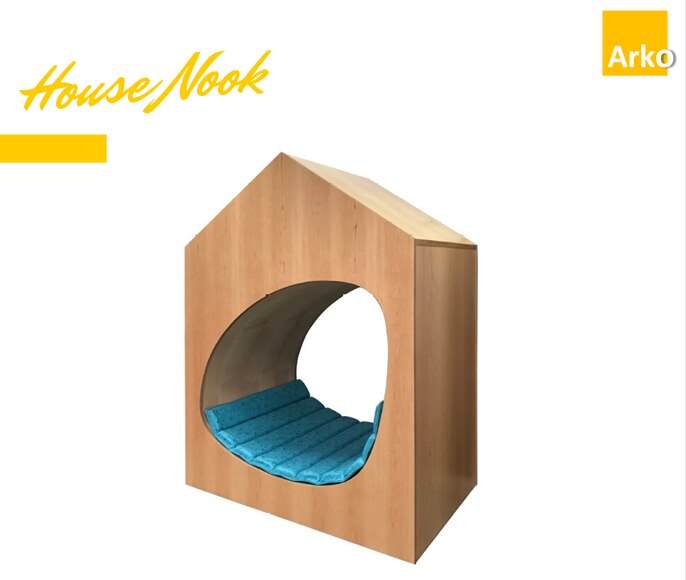 | KINDERGARTEN TABLES A cozy place to read a book alone or with a friend. Colorful fabric an finish options can really brighten up library or school spaces and make it... View product → |
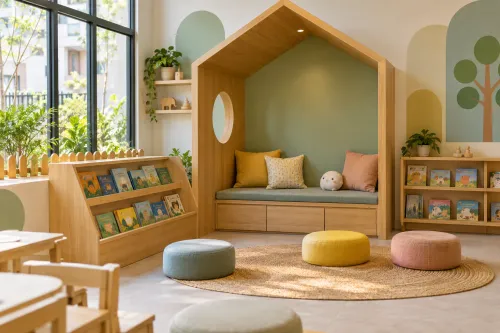
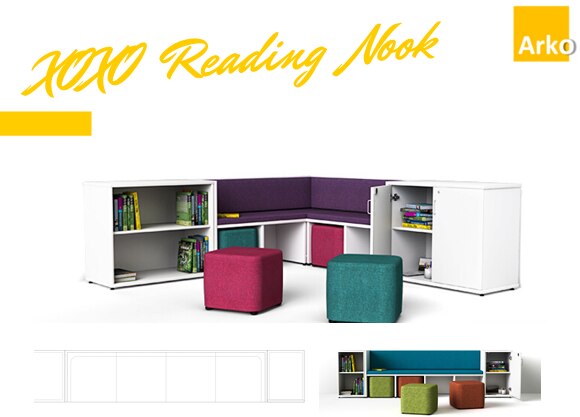 | KINDERGARTEN TABLES The XOXO Reading Nook is the perfect element to include into any classroom that needs a quiet reading space. View product → |
Frequently asked questions
What counts as activity furniture in a kindergarten room?
Activity furniture includes movable or fixed tables, workbenches, easels, dramatic-play units, storage, display surfaces and floor-level work areas that support hands-on actions.
Which furniture format fits each kindergarten activity?
Use washable tables for art and sensory work, sturdy low surfaces for building, easels for painting, open-ended units for pretend play and accessible storage for independent setup and cleanup.
What dimensions and group sizes should you specify?
Specify the furniture’s height, work-surface dimensions, storage reach and intended number of children, then match each format to the activity and supervision needs.
How can you arrange stations for movement, noise and supervision?
Keep clear routes between stations, place messy work near sinks, separate loud construction from quiet activities and position furniture so adults can see every zone.
What should you check before buying activity furniture?
Check stability, rounded edges, pinch-point protection, non-toxic finishes, washable surfaces, accessible storage, repairable parts and suitability for the intended activity.
Related products
 | SHAPES / LAYOUTS Arko Global is one of the leading manufacturers of kindergarten shapes and layouts in Bangalore, specializing in creative, safe, and child-friendly... View product → |
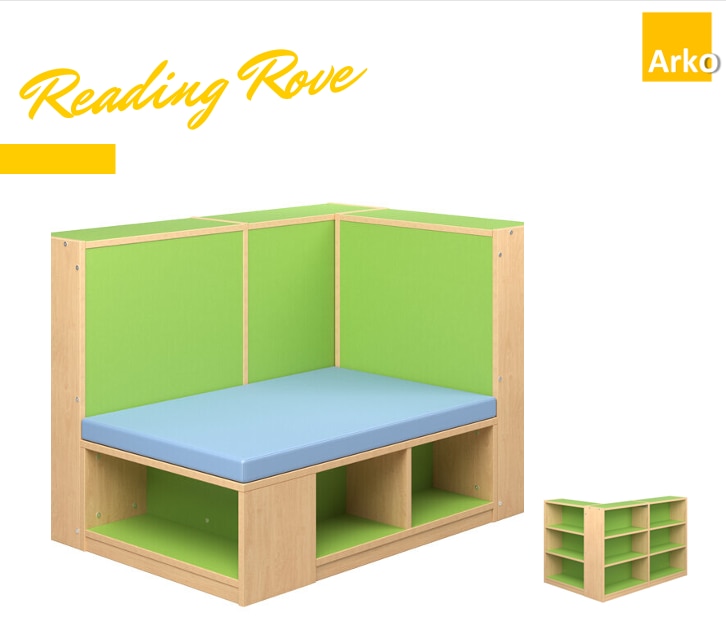 | KINDERGARTEN TABLES After picking out a book, you need to find a comfortable place to enjoy it. View product → |