A chair can have the right age label and still leave a child’s feet dangling, hips sliding forward, or shoulders raised above the desk. By the end, you will know how to measure a student, test the chair–desk combination, choose between fixed and adjustable furniture, and specify a classroom layout that supports movement as well as seated work.
Key takeaways
- Keep both feet supported and knees near a right angle.
- Check seat depth, desk height, back support, and elbow position.
- Choose adjustable furniture when one size cannot fit the student range.
- Inspect dimensions, materials, stability, edges, and adjustment mechanisms before buying.
How do furniture dimensions change a child’s seated posture?
Furniture dimensions alter posture by determining whether a child can sit back, support the thighs, and reach the work surface without strain. A seat height that is too high leaves feet dangling; one that is too low raises the knees.
If seat depth exceeds the child’s buttock-to-popliteal length, the child slides forward or slouches to reach the backrest. A shallow seat reduces thigh support.
- A shaped backrest can support the trunk, but a high or rigid contour may obstruct forward writing, turning, or collaborative perching.
- Desk height must match elbow height: a high surface lifts the shoulders, while a low one encourages a rounded back and excessive neck flexion.
- Stable foot support lets a small child keep the lower legs supported instead of bracing against the seat or desk. A broad foot bar must not obstruct entry or cause trips.
- Chair–desk compatibility matters more than either item alone. A well-fitted chair paired with a low desk still bends the neck and back; a suitable desk cannot correct dangling feet.
A soft seat feels comfortable but does not guarantee support. Foam that compresses unevenly, a deep pan, or a backrest that misses the child’s trunk can preserve poor posture beneath a pleasant surface.
Specify school chair dimensions, including seat height and seat depth, and test the complete workstation during writing and screen use; a tablet placed on a writing-height desk may still sit too low. The search phrase seat depth educational furniture Berformance? should never replace measured dimensions and observed fit.
How can you check whether a chair and desk fit a student?
Measure the student, not the age label. A practical student furniture fit check uses school furniture anthropometry: popliteal height, buttock-to-popliteal length, and seated elbow height, then compares each measurement with the chair and desk dimensions.
| Measurement | How to take it | Furniture comparison |
|---|---|---|
| Popliteal height | Measure from the floor to the knee crease while seated, with the thigh level | Compare with seat height; the feet should rest flat and the knees stay near 90 degrees |
| Buttock-to-popliteal length | Measure from the back of the buttocks to the back of the knee | Compare with seat depth; excessive depth causes forward sliding, while a shallow seat reduces thigh support |
| Seated elbow height | Measure from the seat surface to the underside of the relaxed elbow | Compare with child desk height; elbows should reach the work surface without raised shoulders |
Seat height alone does not prove a good fit. Check the complete chair–desk combination while the student writes, reads, and uses a device: thighs should remain supported, the back should contact the backrest, shoulders should stay level, and elbows should reach the surface comfortably.
Look for these mismatch signs:
- Dangling feet or knees forced sharply upward
- Hips sliding forward to reach the backrest
- A rounded back, sideways sitting, or unsupported thighs
- Elevated shoulders or elbows held away from the body
- Excessive neck flexion while viewing a book, tablet, or laptop
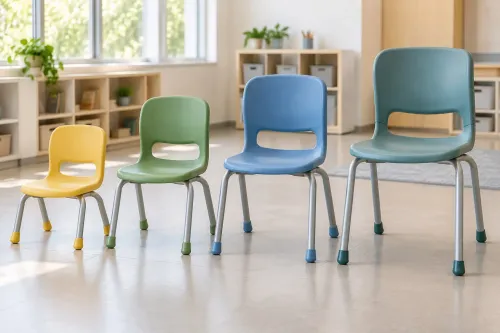
Age ranges and colour-coded size bands speed distribution but cannot capture body-size differences within one age group. Compare the manufacturer’s dimensions with your students’ measurements; “ages 6–8” is not a fit guarantee.
What should furniture support during writing, reading, drawing, and screen use?
A writing posture classroom check starts with the work surface: handwriting needs forearms supported, shoulders relaxed, and a desk close enough to prevent leaning.
Drawing needs the same elbow support but more freedom to move the arm across the page, while reading benefits from a tilted book surface or a reading position that reduces prolonged neck bending.
Screen work changes the height problem. A laptop or tablet placed flat for typing can leave its screen too low, causing neck flexion; screen ergonomics for students may require a raised display with a separate keyboard, a tablet stand, or a higher perch for short tasks.
- Match the chair to the activity. Use backrest support for sustained writing or reading, but avoid a high, deeply contoured back that blocks turning, forward perching, or quick collaboration.
- Test the position during each task. Check that elbows reach the writing surface without raised shoulders, the screen sits near eye level, and the child can change position without sliding forward.
- Plan the classroom furniture layout around movement. Place individual desks with clear entry and exit paths, reading areas where children can shift between sitting and floor-level positions, and group-work tables close enough for conversation without awkward reaches.
- Keep bags, chair legs, and foot bars outside routes. A stable footrest helps when feet do not reach the floor, but a poorly placed bar creates a trip hazard.
Furniture should support movement, not force one “correct” posture all day.
When should a school choose adjustable furniture rather than fixed sizes?
Choose adjustable school furniture when local body-size variation makes a single size unreliable and staff can manage the settings. Fixed-height classroom furniture works when dimensional tables show that the school’s pupils fit the available size range, classrooms have stable age groups, and the lower purchase and maintenance cost matters more than an exact fit.
| Option | Strength | When it applies |
|---|---|---|
| Fixed-height classroom furniture | Lower cost, fewer parts to inspect, no daily setup | Most pupils fit the selected size, and classrooms change little |
| Adjustable furniture | Better fit across different popliteal heights and desk tasks | A wide range of body sizes shares a room, or furniture moves between year groups |
| Hybrid provision | Fixed sizes for most pupils, adjustable units for outliers | Only a smaller group needs extra height, depth, or foot support |
Adjustability fails if settings stay at delivery height. Require clear size markings, tool-free operation, guarded pinch points, stable foot bars, and an inspection routine for loose knobs, damaged mechanisms, and uneven heights. Train staff to check settings after room changes; avoid systems that require lengthy daily adjustment.
Use a footrest classroom chair when feet cannot reach the floor. Its bar must support different foot positions without blocking entry or becoming a trip hazard. Do not lock children into one upright pose: schedule movement and let posture variation students use include turning, perching, standing, and changing work zones.
What should you specify and inspect before buying ergonomic classroom furniture?
Specify fit as a measurable acceptance condition, not as an “ages 6–8” label. Compare the manufacturer’s dimensional table with your local pupil population and state the percentage or body-size range expected to fit each size. Require clear size codes or colour bands on every chair and desk.
- Name EN 1729-1 for functional sizes and EN 1729-2 for safety requirements and test methods.
- Require a classroom trial during handwriting, drawing, reading, and device work; inspect feet, knees, thighs, elbows, shoulders, screen reach, and freedom to turn.
- State seat height and seat depth separately. A deep pan encourages forward sliding; a shallow pan reduces thigh support.
- Define fit targets: feet flat, knees near 90 degrees, supported thighs, level shoulders, and elbows reaching the work surface without neck or shoulder strain.
- Specify a backrest that supports the trunk without blocking forward writing, perching, or collaboration.
Include service-life tests in the school furniture procurement document.
| Inspection point | Evidence to request | Reject when |
|---|---|---|
| Seat and back | Compression test and joint inspection | Foam stays collapsed or back joints move |
| Edges | Sample inspection after use testing | Edge bands lift, split, or expose sharp corners |
| Height mechanism | Cycle-test result and replacement parts list | Adjustment binds, loosens, or lacks serviceable parts |
| Installation | Signed post-installation adjustment check | Sizes remain unmarked or settings do not fit pupils |
Arko Global is one example of a manufacturer whose value should be judged against these specifications, not appearance alone. That evidence makes ergonomic furniture inspection repeatable before purchase and after installation.
Frequently asked questions
How do furniture dimensions change a child’s seated posture?
Seat height affects foot support and knee position, while seat depth, backrest angle, and desk height affect pelvic position, back support, shoulder tension, and reach.
How can you check whether a chair and desk fit a student?
Check that feet rest on the floor, knees stay near a right angle, the back contacts the backrest, thighs are supported, and elbows reach the work surface without raised shoulders.
What should furniture support during writing, reading, drawing, and screen use?
It should support stable feet, an upright but flexible trunk, relaxed shoulders, supported forearms, clear viewing distance, and enough surface area for each activity.
When should a school choose adjustable furniture rather than fixed sizes?
Choose adjustable furniture when students vary widely in height, furniture must serve multiple age groups, or the room needs to support changing activities.
What should you specify and inspect before buying ergonomic classroom furniture?
Specify seat and desk dimensions, adjustment ranges, load capacity, materials, edge treatment, stability, cleanability, repair access, and compliance documents, then inspect samples in person.